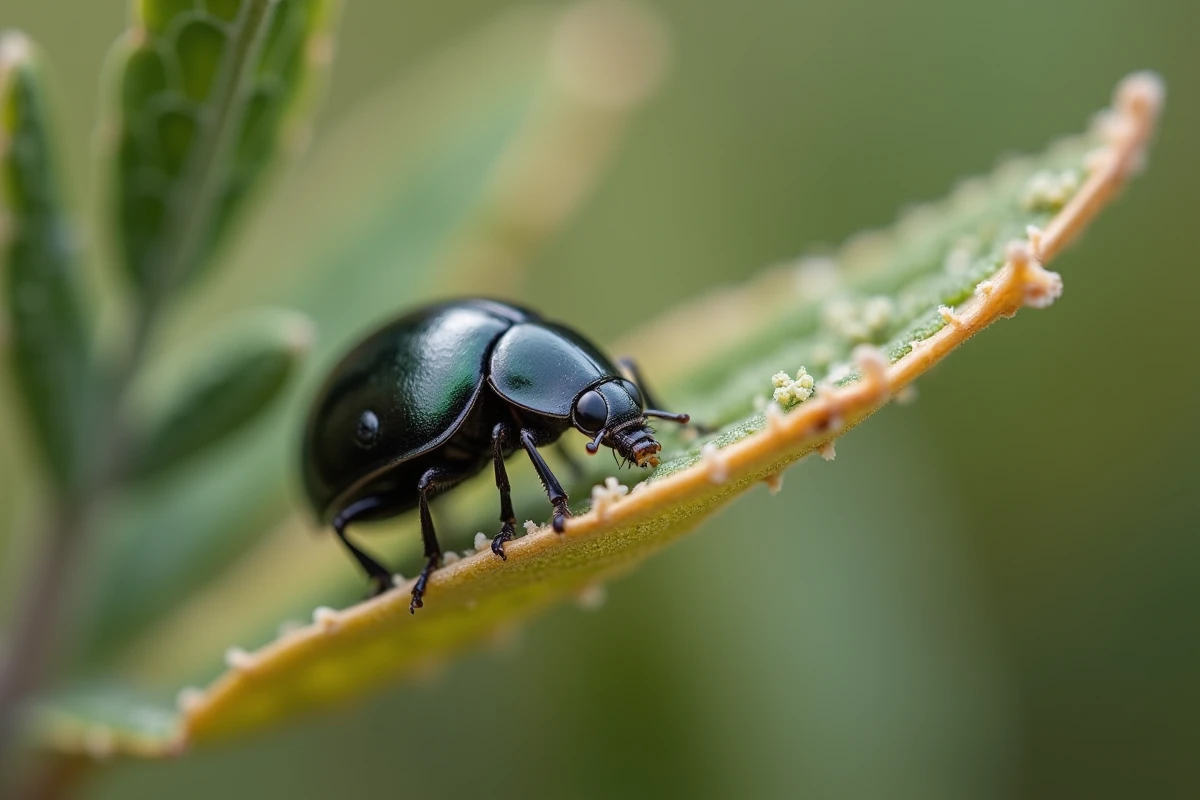
The black ladybug intrigues more than its red cousin. Where the classic spotted ladybug triggers an immediate smile, the dark variant elicits mixed reactions, sometimes tinged with suspicion. The question deserves to be asked from a precise angle: what is it about the black color of this insect that fuels such varied spiritual interpretations, and on what basis do they actually rest?
Black Ladybug vs. Red Ladybug: Comparative Perceptions
The difference in treatment between the red ladybug and the black ladybug does not lie in biology. Entomologists remind us that entirely black or very dark ladybugs are often melanic forms of common species, notably the Asian ladybug Harmonia axyridis. Their ecological role remains the same: predation of aphids, natural protection of crops.
Public perception tells a different story. Dark ladybugs are seen as “less friendly” or “suspicious” compared to red spotted ladybugs. This reaction feeds specific negative beliefs that, notably, are not rooted in ancient traditions.
| Criterion | Red Spotted Ladybug | Black Ladybug |
|---|---|---|
| Public Perception | Good luck, divine messenger | Suspicion, curiosity, sometimes fear |
| Biological Basis | Same species (often Harmonia axyridis) | Melanic form of the same species |
| Ecological Role | Aphid predator | Aphid predator (identical) |
| Traditional Roots | Medieval legends, “Beast of God” | No documented ancient tradition |
| Spiritual Symbolism | Luck, love, protection | Transformation, introspection, end of cycle |
This table highlights a striking gap: the negative symbolism of the black ladybug is a recent construction, amplified by social media and esoteric websites, without foundation in documented ethnological or entomological traditions. To delve deeper into the spiritual meaning of the black ladybug, it is essential to distinguish between what pertains to cultural symbolism and what relates to contemporary projection.
Numerology of Spots on Black Ladybug: A System of Symbolic Reading
The most structured spiritual interpretation surrounding the black ladybug comes from a numerological grid that associates the number of spots and the body color with specific vibrations. This system, notably described by the site Anïwal, proposes body/spot combinations interpreted as symbolic codes.
Black Body with No Visible Spots
An entirely black body, with no discernible spots, is associated with the energy of the number 8: end of cycle and assessment. In this reading, encountering a solid black ladybug would invite one to take stock of a life period that is coming to an end. The message would focus on letting go, closing a situation rather than a bad omen.
Black Body with Two Red Spots
The presence of two red spots on a black background is interpreted as a vibration of 2 superimposed on the transformative background of 8. This combination would direct the message towards the relational sphere: a signal to clarify an ongoing relationship, whether friendly, romantic, or professional.
This reading system, although it is not based on any scientific foundation, offers a more nuanced framework for reflection than the simple “good or bad omen.” The richness of the interpretation lies in the combinatorial:
- The number of spots modifies the base message related to the body color
- The color of the spots (red on black, or vice versa) sometimes reverses the reading
- The complete absence of spots constitutes a message in itself, distinct from a monochrome red ladybug
Black Ladybug and Death Omen: Origin of a Belief Without Ancient Roots
The association between black ladybug and death circulates abundantly online. Searches related to the words “black ladybug meaning death” generate a notable volume of queries. This belief deserves to be examined closely.
No documented ancient tradition associates the dead black ladybug with a human death omen. The link “black ladybug = death” is a recent construction, primarily amplified by online content. Ethnologists and entomologists have not found any ancient folkloric or religious source supporting this idea.
In contrast, the red ladybug benefits from centuries of positive traditions. Its nickname “Beast of God” dates back to the Middle Ages. It carries dozens of regional names in France: “Poulette au Bon Dieu” in Calvados, “Petite vache à Dieu” in Lower Normandy, “Cheval de la Vierge” elsewhere. The black ladybug has no equivalent in this traditional repertoire.
Transformation and Protection: Recurring Themes in Black Spiritual Symbolism
Beyond numerology and false beliefs about death, two recurring axes of interpretation emerge in the spiritual interpretations of the black ladybug.
The first is inner transformation. Black, in most symbolic systems, refers to introspection, passing through the shadow before renewal. The ladybug, through its natural metamorphosis (larva to winged adult), already embodies this process. Its black version would concentrate the intensity of this process.
The second axis is protection. The red ladybug is associated with divine protection in European Christian traditions. The black ladybug, by extension, would carry a message of protection during difficult transitional periods, where vulnerability is at its highest.
- The black color amplifies the introspective dimension of the symbolic message
- The biological metamorphosis of the insect serves as a concrete support for the theme of transformation
- The associated protection targets moments of transition, not everyday life
These two axes converge: the black ladybug, in contemporary spiritual reading, signals a pivotal period. The message is less about an external event than about a work of inner reflection to be undertaken or already in progress.
The black ladybug remains an ordinary insect for entomology, a melanic form without ecological particularity. Its symbolic charge, however, rests entirely on contemporary interpretations without traditional anchoring. The fact that these readings are structured around numerology and life cycles, rather than ancient superstitions, likely speaks more about current needs for meaning than about the insect itself.