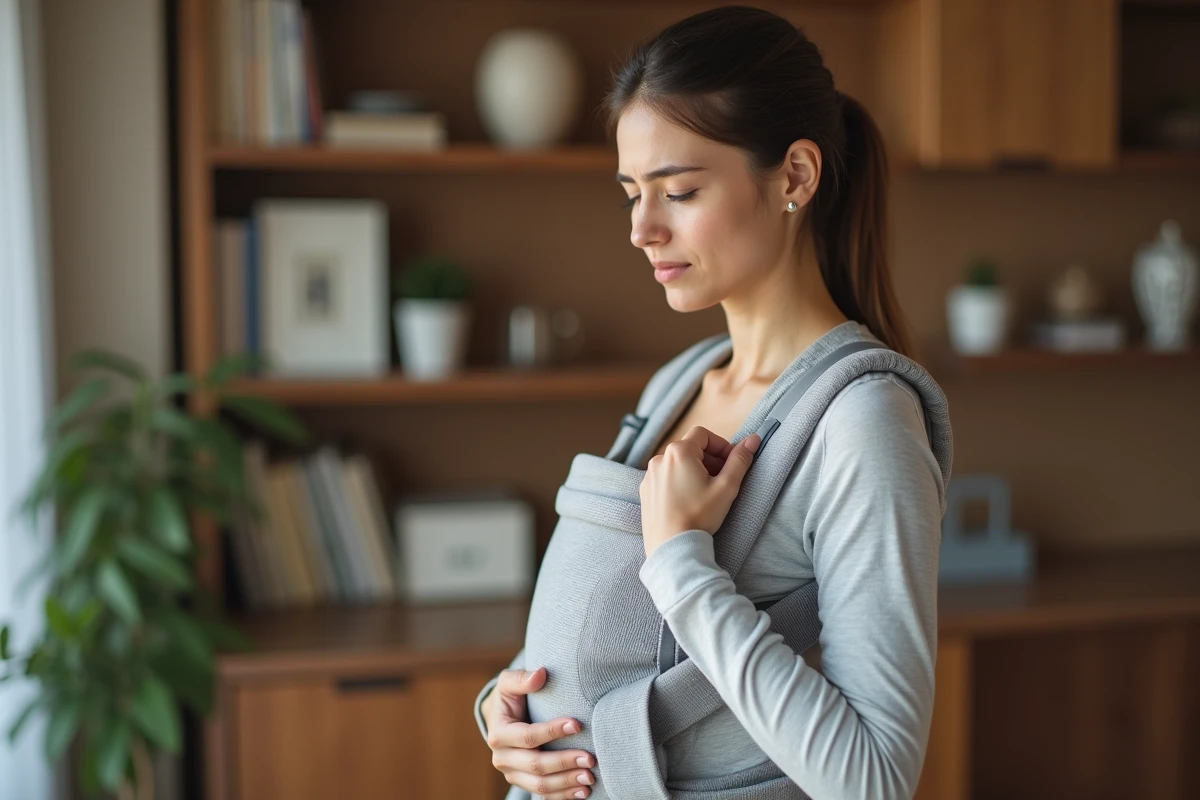
You have been carrying your baby against you for an hour, and a dull discomfort settles between your shoulder blades or under your sternum. This chest pain related to carrying affects a notable proportion of young parents, often starting in the first few weeks. It is not mysterious: it results from specific, identifiable, and correctable mechanical constraints.
Asymmetrical muscle overload: the mechanism behind the carrier’s chest pain
When a parent carries their baby on the same arm or always on the same side, the load concentrates on a few muscles. The trapezius, serratus anterior, and rhomboids work overtime on one side of the chest. This prolonged imbalance creates tensions that radiate towards the ribs, sternum, or spine.
Carrying behaves like a repetitive physical activity. Research in ergonomics published after 2020 classifies prolonged carrying among tasks at risk of musculoskeletal disorders, on par with certain professional gestures. Carrying for more than three hours a day on the same side significantly increases shoulder girdle and thoracic spine pain in both young mothers and fathers.
You can find health information on Optisanté that details these mechanisms and the signals to watch for in carrying parents.

Adjusting the baby carrier: the mistakes that cause pain
Have you ever noticed that chest discomfort appears more with certain baby carriers than with others? The problem rarely comes from the model itself. It comes from the adjustment.
The baby’s height
The recommended guideline from carrying instructors and perinatal physiotherapists is simple: the baby’s forehead should be at kiss height. If the child is too low, the parent’s center of gravity tilts forward. The back muscles constantly compensate, and the pressure shifts to the ribs and sternum.
The incorrectly positioned waist belt
Many parents place the carrier’s belt at waist level, or even above the navel. This position transfers the load to the lower back and chest. The belt should rest on the iliac crests, that is, on the hips, so that the pelvis and gluteus maximus absorb the baby’s weight.
Loose straps
Loose straps allow the baby to sag. The parent compensates by raising their shoulders or arching their back. The scapular stabilizers contract for an extended period, causing pain between the shoulder blades and around the sternum.
- Check the baby’s height at each setup: forehead at kiss height, chin clear, back rounded in a C shape
- Place the belt on the hips, not on the waist, and tighten it firmly before positioning the child
- Adjust the straps so that the fabric is taut without compressing, distributing pressure symmetrically across both shoulders
- Alternate the carrying side if you are using a hip carry or one arm

Physiological carrying and load redistribution on the pelvis
A well-adjusted baby carrier does not just relieve the shoulders. It changes the complete biomechanics of the carrier. The load descends towards the pelvis, the pelvic floor muscles and gluteus maximus participate in support, and the thoracic muscles regain a light stabilizing role rather than forced maintenance.
Recent recommendations from perinatal professionals emphasize the symmetry of support points. A symmetrical carry significantly reduces the sensation of weight on the chest and trapezius from the very first correctly adjusted uses. It is not a matter of brand or price of the baby carrier, but of the technique of setup.
For parents using a baby wrap, the principle remains the same. Each layer of fabric should be pulled strand by strand, from one knee to the other, so that the tension is even. A wrap that is not tightened properly in one area creates a localized compression point on the carrier’s chest.
When the carrier’s chest pain is not muscular
The majority of chest pain in carrying parents is of parietal origin: muscles, costal cartilages, postural tensions. Pain that appears only during or just after carrying, that reproduces upon palpation, and that decreases at rest clearly points to a mechanical cause.
Some signals should prompt immediate consultation: chest pain that persists at rest, unusual shortness of breath, pain radiating to the left arm or jaw, palpitations. These symptoms are not related to carrying and require prompt medical advice.
Stress and lack of sleep in the early months also worsen the perception of pain. Parental anxiety amplifies thoracic muscle tensions through a reflex contraction mechanism. An exhausted parent carries differently: raised shoulders, shallow breathing, frozen posture. This cycle can maintain the pain well beyond the carrying session.
- Pain reproduced by pressure on the ribs or sternum: likely mechanical cause, related to carrying or posture
- Persistent pain at rest, unrelated to position: medical consultation recommended
- Discomfort associated with fever, cough, or shortness of breath: possible respiratory origin, to be evaluated by a healthcare professional
Correcting the adjustment of the baby carrier and alternating positions is sufficient in the vast majority of cases to make chest pain disappear within a few days. A well-adjusted carry protects the parent’s back and chest as much as it supports the baby. Taking five minutes to check each support point before heading out is the most cost-effective gesture for carrying without pain over time.