
The sustainable clothing market is no longer just a niche driven by a few committed brands. By 2025, the growth figures for the ethical segment will surpass those of conventional fashion, and several structural indicators allow us to measure this shift. Understanding this data is key to grasping the current state of the textile sector’s transition.
Upcycled Fashion: The Segment Redefining Textile Growth
Among all the sub-segments of sustainable fashion, upcycled fashion shows the most spectacular trajectory. According to Fortune Business Insights, the global upcycled fashion market is expected to reach approximately 8.98 billion USD by 2025, with a projection of 19.47 billion USD by 2029.
This near doubling in four years cannot be explained solely by consumer enthusiasm. It also reflects the entry of mainstream brands into the upcycling sector, transforming dormant stock or production waste into new collections. Upcycling is thus shifting from a craft gesture to an industrial logic.
To place this data within the broader context of the evolution of sustainable clothing in 2025, it is important to note that this segment is growing much faster than traditional ready-to-wear, whose sales in France remain below 2019 levels according to the IFM.
Growth Rate of Ethical Fashion Compared to the Global Market
Broadly speaking, ethical fashion (responsible materials, certified supply chains, production transparency) shows an annual growth rate of approximately 9.66% projected until 2033, according to Global Market Statistics. This pace significantly exceeds that of the traditional textile market.
In comparison, clothing sales in France fell by 0.1% in value in the first half of 2025 compared to 2024, according to the French Institute of Fashion. The French market remains 9.7% below its 2019 level.

The outperformance of the sustainable segment is therefore not just a marketing effect. Brands that incorporate ethical lines capture an increasing share of a stagnating global market. This gap between the sustainable dynamic and the sluggish conventional market is the major structural fact of 2025.
Luxury and Sustainability: When Major Houses Quantify Their Commitments
The luxury fashion sector exemplifies this migration towards sustainability. Market Research Future estimates this market at 289.05 billion USD in 2024, with a projection of 299.06 billion USD in 2025. The report describes a dynamic shift towards sustainability and ethical practices, particularly in North America.
In practical terms, luxury houses are no longer satisfied with “green” capsules. They are publishing quantified goals for impact reduction and integrating sustainability into their brand strategy. Gildan, for example, published a sustainability report in 2025 detailing its progress on specific social and environmental targets.
This shift has a ripple effect on the rest of the market. When luxury adopts traceability standards, mass-market brands are compelled to follow to avoid appearing outdated in the eyes of increasingly demanding consumers.
French Consumer Expectations: What Recent Surveys Reveal
The demand-side figures confirm the pressure on brands. According to the Trustpilot report, 79% of French respondents stated that they would likely stop buying from brands that are insufficiently committed to ethical practices.
An IFOP study conducted with Purpose Lab and the media Nouveau Modèle provides additional insights:
- About 70% of French women value the places and conditions under which the products they buy are made
- 64% say they are willing to spend more to ensure responsible sourcing in terms of CSR
- Transparency regarding production methods is becoming a loyalty criterion, not just a one-off selling point
The willingness to pay more for sustainable products is no longer marginal; it concerns a majority of surveyed consumers. This gap between declared intent and actual sales in the ethical market suggests that the accessible supply remains insufficient to convert this demand into regular purchases.
Environmental Labeling: The Regulation That Will Reshape the Landscape
The rollout of environmental labeling on clothing, scheduled for fall 2025 by the French government, will change the rules of the game. Originating from the Climate and Resilience Law and proposals from the Citizens’ Climate Convention, this system assigns each garment a score expressed in “impact points.”
This score takes into account several dimensions:
- Greenhouse gas emissions over the entire life cycle
- Impacts on biodiversity and water consumption
- The durability of the product and pollution effects on environments
For brands, this measure makes greenwashing much riskier. A garment displayed with a high environmental cost will be directly comparable to a more virtuous alternative. Environmental labeling transforms sustainability into a visible data point at the time of purchase.
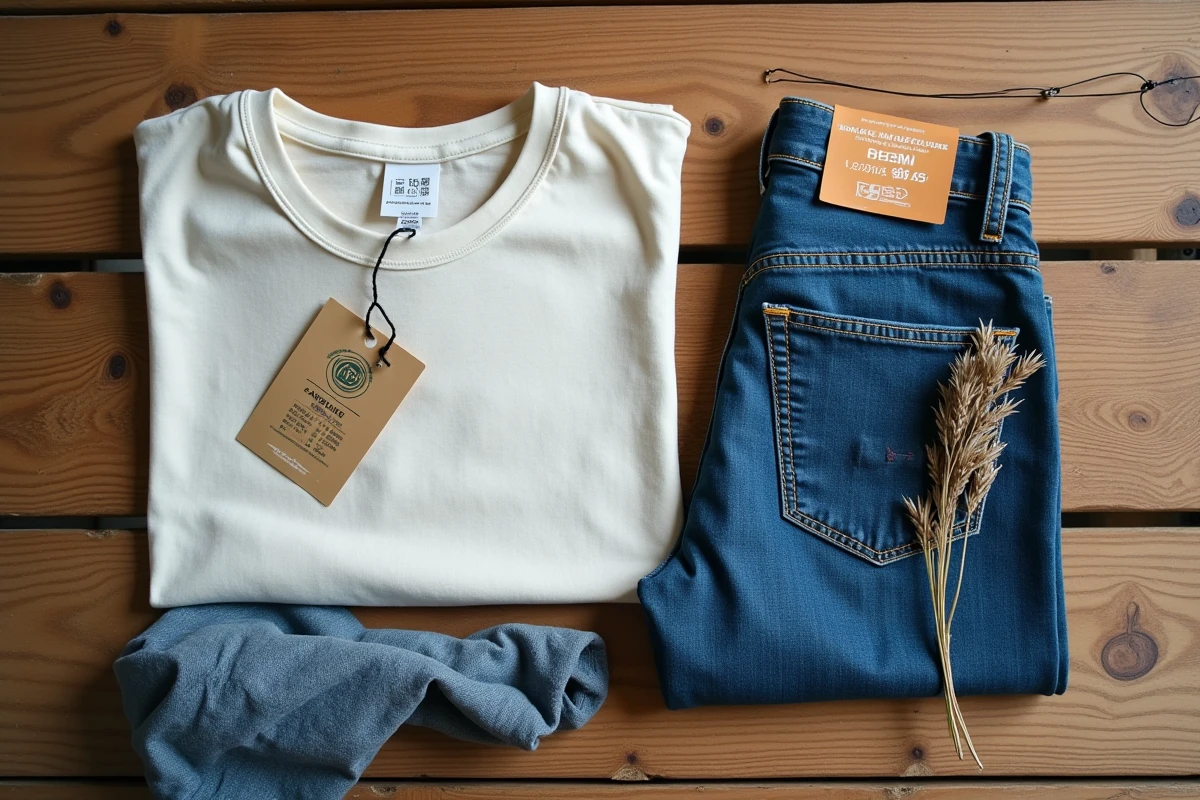
The online sales channel, which grew by 0.7% in value in the first half of 2025 compared to 2024 according to the IFM, will also need to integrate this labeling. Marketplaces and brand sites will have to adapt their product listings, which could favor players already structured around traceability.
The figures for 2025 outline a two-speed textile market. On one side, a rapidly growing sustainable and ethical segment driven by consumer demand and soon regulated. On the other side, a conventional market struggling to regain its pre-crisis levels. The question for brands is no longer whether the transition to sustainability is profitable, but how quickly it will become the standard reference.