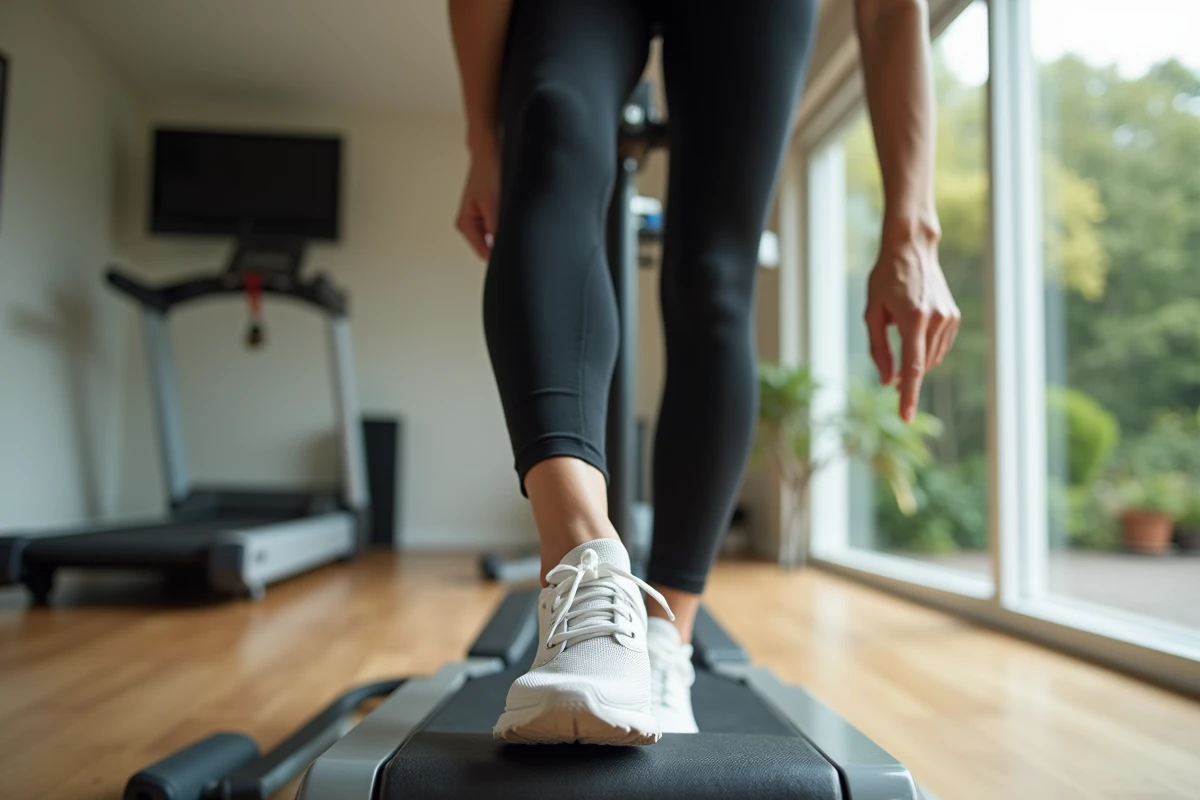
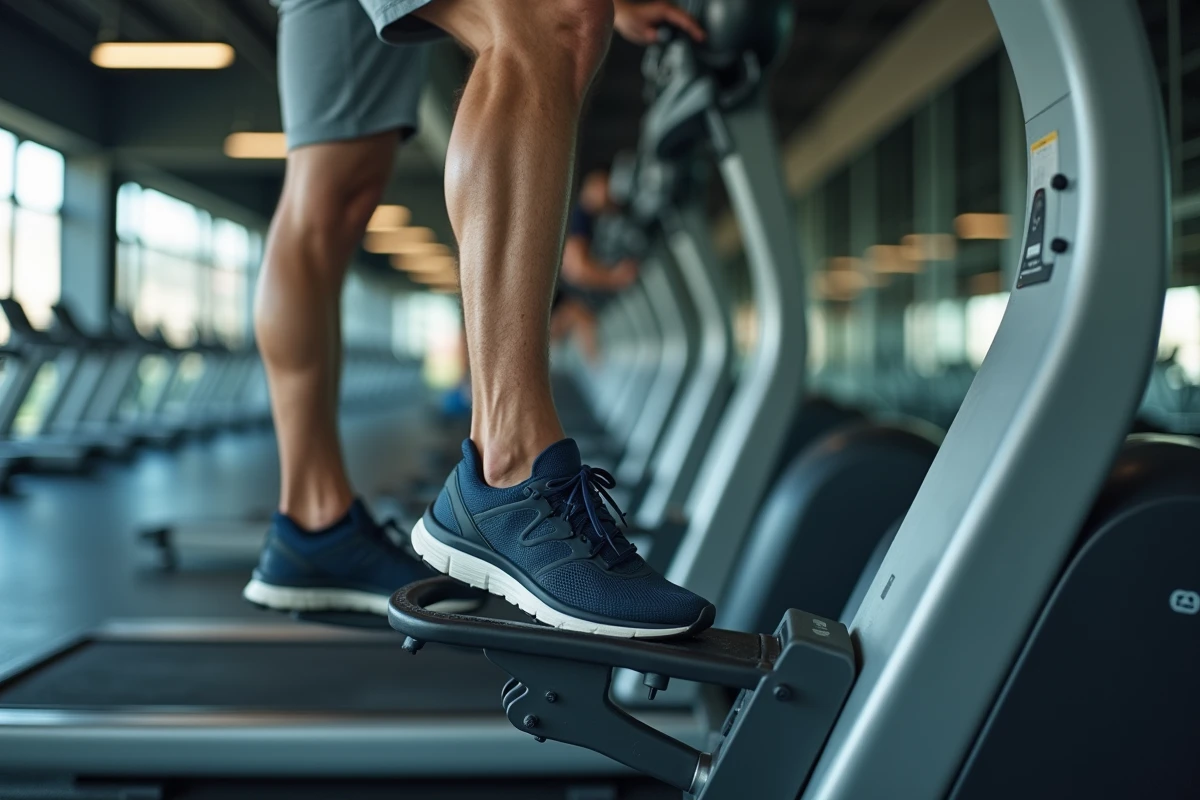
On an elliptical bike, the pedal accommodates the entire foot, but the support area and the orientation of the shoe radically change the muscles engaged and the joint stresses. Positioning your feet on an elliptical bike is not just about getting on the pedals: the distribution of plantar pressure, the angle of foot rotation, and the alignment with the knee form a biomechanical trio that determines the effectiveness of each stride.
Plantar pressure and muscle activation on the elliptical
Most guides recommend keeping the foot flat on the pedal. This advice remains valid as a starting point, but it masks a nuance that recent biomechanics research has shed light on.
A study from the University of Wisconsin-La Crosse (Schnurr et al., Journal of Strength and Conditioning Research, preprint September 2024) measured muscle activation via EMG based on the support area. When the push focuses on the forefoot, the gastrocnemius (calves) and toe flexors work harder. When the support shifts to the heel and midfoot, it is the quadriceps and glutes that take over.
In practical terms, this means that the same machine allows targeting different muscle chains simply by moving the pressure area under the foot. To delve deeper into foot positioning on an elliptical bike according to ABC Sports, this logic of plantar distribution constitutes the first lever to master before adjusting resistance or intensity.
Knee-foot alignment: the verbal cue that changes everything
The dynamic valgus of the knee (the knee moving inward with each stride) is one of the most common causes of patellar pain on the elliptical. Telling someone to “keep their feet parallel” is not enough to correct this flaw, because the instruction is too abstract for the body to integrate in motion.
Researchers (Hogg et al., Gait & Posture, volume 104, 2023) filmed the 3D kinematics of 30 beginner users and tested different verbal cues. The result is clear: asking to crush the pedal with the outer edge of the foot significantly reduced the dynamic valgus of the knee compared to the classic cue “feet parallel.”
This tip works because it gives the practitioner a physical contact point to feel. The outer edge of the foot becomes a proprioceptive reference that keeps the knee aligned with the hip without conscious thought.
How to apply this cue during the session
At first, pedal slowly, with low resistance. Focus on the sensation of pressure under the outer edge of each foot. Once the movement is integrated (after a few minutes), gradually increase the cadence. If the knee starts to move inward again, the cadence is too high for your current level of control: slow down.
External foot rotation on the pedals of an elliptical
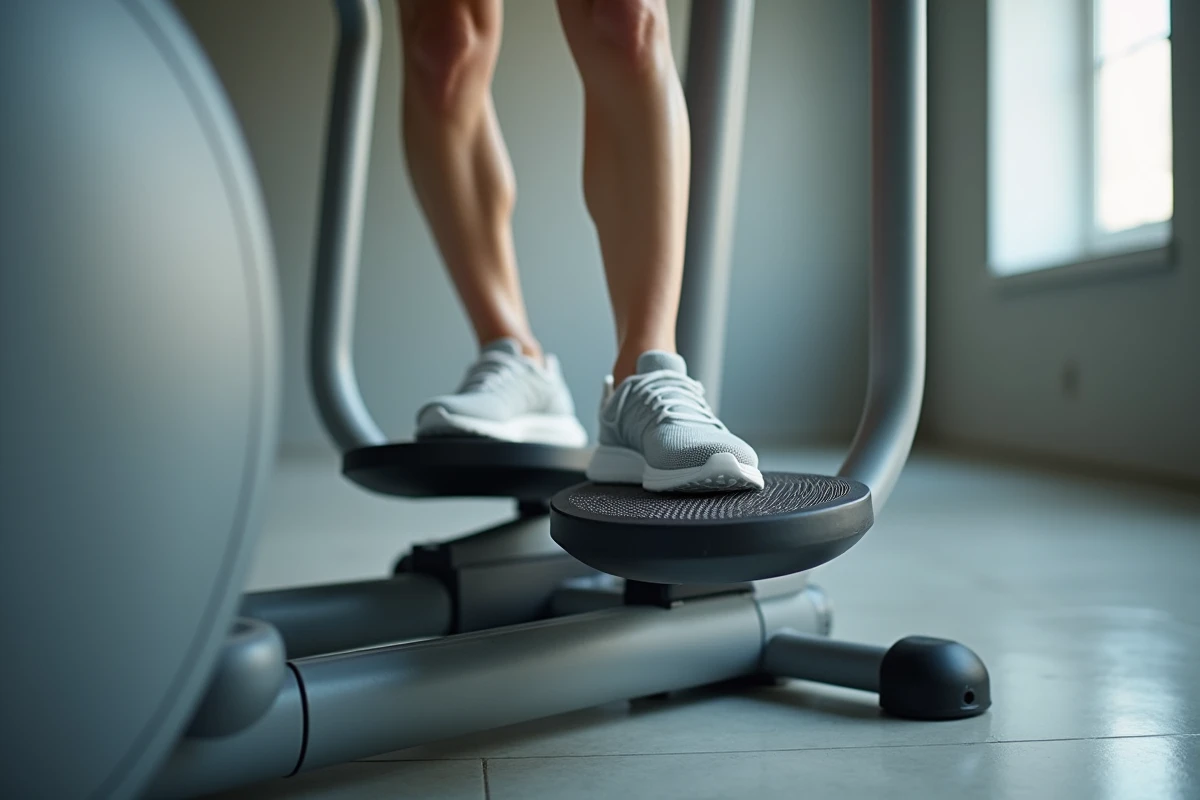
Placing the feet strictly straight on the pedals seems logical, but a slight external rotation of the toes reduces stress on the first ray (the area of the big toe and the first metatarsal). A team of sports podiatrists reported in 2022 that this rotation, between 5 and 10 degrees, decreases pain related to hallux valgus or metatarsalgia in regular practitioners.
This rotation should not be exaggerated. Beyond 10 degrees, the foot overhangs the pedal, creating lateral instability and negating the desired benefit. To find the right angle, stand on the pedals while stationary, let your feet position themselves naturally, and then check that the toes are slightly open without the heel sliding towards the inner edge.
Common foot placement errors to correct on the elliptical
Three recurring flaws can be easily corrected once identified.
- Heel lifting with each stride: the foot tilts forward, the load concentrates on the metatarsals, and the Achilles tendon endures repetitive stretching. The solution is to consciously lower the heel during the downward phase of the movement, as if you want to “sink” the back of the pedal.
- Foot placed too far forward on the pedal: the toes extend beyond the edge, blood return is compressed, and numbness appears after a few minutes. Move the foot back so that the front of the shoe remains within the surface of the pedal.
- Asymmetrical support between the left and right foot: one side pushes harder, the pelvis shifts, and lumbar tension develops. To detect this, close your eyes for a few seconds while pedaling slowly and feel if one leg is doing more work than the other. The adjustment involves paying deliberate attention to the weaker side during the first few minutes of each session.
The role of the handlebars in foot balance
Gripping the fixed handlebars shifts the center of gravity forward and increases pressure on the forefoot. Using the movable arms, by actively pushing and pulling, distributes body weight more evenly across the entire pedal. Feet remain flatter more naturally when the upper body participates in the movement.
Adapting foot placement according to training goals
The position of the feet is not fixed: it can evolve within the same session to vary muscle work.
- To target the glutes and quadriceps during high-resistance efforts, maintain a marked heel-midfoot support and keep the torso slightly upright.
- To engage the calves and toe flexors more during high-cadence intervals, allow pressure to migrate towards the forefoot while ensuring that the heel does not lift completely.
- For a long endurance session at moderate intensity, alternate between the two types of support every five to ten minutes to distribute fatigue and avoid numbness related to prolonged static pressure.
The choice of support area works in conjunction with adjusting resistance and cadence. Modifying plantar pressure remains the simplest parameter to adjust without interrupting the effort, unlike resistance which often requires letting go of the movable handlebars to reach the console.
One last often-overlooked point: the shoe size. A model that is too tight compresses the foot on the pedal and prevents the natural micro-adjustments of the arch. Opt for a shoe with half a centimeter of margin at the front, without wearing a pair that is too loose that would slide laterally on the pedal.